
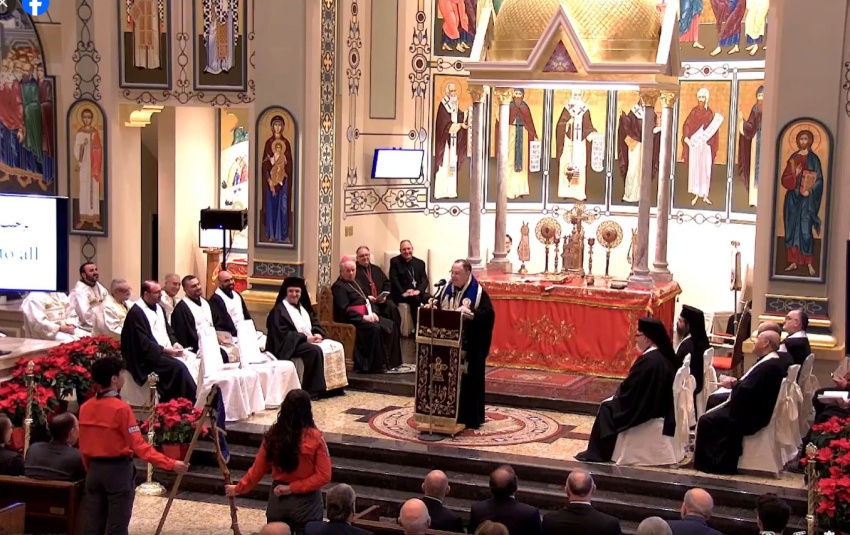
(𝐅𝐫𝐞𝐧𝐜𝐡 𝐚𝐧𝐝 𝐄𝐧𝐠𝐥𝐢𝐬𝐡 𝐯𝐞𝐫𝐬𝐢𝐨𝐧𝐬 𝐰𝐢𝐥𝐥 𝐟𝐨𝐥𝐥𝐨𝐰)
كلمة سيادة المطران ميلاد الجاويش راعي أبرشيّة كندا للروم الملكيّين الكاثوليك
في سهرة الصلاة بمناسبة الذكرى المئويّة الثالثة لإعادة الشركة الكنسيّة
بين الكنيسة الروميّة الأنطاكيّة وكنيسة روما (1724-2024)
الجمعة 19 كانون الثاني 2024
نجتمع اليوم في سهرة الصلاة هذه، تحت سقف كاتدرائيّة المخلّص، وفي قلوبنا رغبة واحدة وهي أن نُفرح قلب المخلّص بأن نحبّ بعضنا بعضًا وبأن نكون جميعُنا واحدًا، كما هو واحدٌ مع أبيه السماويّ.
اسمحوا لي، بدايةً، أن أرحّب بسعادة السفير البابويّ في كندا المونسنيور إيفان يوركوفيتش، في سهرة الصلاة هذه التي فيها نحتفل بالذكرى المئويّة الثالثة على إعادة الشركة الكنسيّة بين الكنيسة الروميّة الملكيّة الأنطاكيّة وكنيسة روما (1724-2024). حضوركم بيننا، يا سعادة السفير، هو علامة حسّيّة على تمسّك كنيستنا الملكيّة الشديد بالإيمان الكاثوليكيّ واعترافًا منها بأبوّة الأب الأقدس الروحيّة.
أن نحتفل بالذكرى المئويّة الثالثة على إعادة الشركة الكنسيّة بين الكنيسة الروميّة الملكيّة الأنطاكيّة وكنيسة روما هو أبعد من أن يكون يوبيل فرح، خصوصًا أنّ الانقسام الذي حصل في القرن الثامن عشر، في قلب الكنيسة الروميّة الملكيّة الأمّ، بين الروم الكاثوليك والروم الأرثوذوكس قائمٌ دائمًا. هذه المناسبة أراها بالأحرى وقفة ضمير وإعادة قراءة لحضورنا الكنسيّ، لأفراحنا وآلامنا، لأمجادنا وخطايانا. لن نحتفل باليوبيل كاملًا إلّا عندما نحقّق إرادة الربّ، الأعزّ على قلبه، ألا وهي أن يكون أبناؤه كلّهم واحدًا في المحبّة وفي الشهادة للإنجيل.
هذه الذكرى ليست أيضًا احتفالًا بعيد مولد كنيستنا. فنحن لم نولد سنة 1724، لأنّ كنيستنا هي كنيسة رسوليّة، آبائيّة، مجمعيّة، تتوارث إرثًا عظيمًا تَكوّن مع الرسل الأوائل وتَنَاقله خلفاؤهم وقدّيسو أنطاكيا العظماء.
أنطاكيا هي الأرض التي فيها وُلدَت كنيسة يسوع، هي حقل بشارة الرسل الأوّل، هي بطريركيّة الأجداد العظيمة التي امتدّت من جنوب آسيا الصغرى إلى فلسطين مرورًا بسوريا ولبنان والأردنّ وسائر المشرق. من هذه الأرض المباركة نحن أتينا وخرجنا. أنطاكيا هي الكنيسة الأولى، النَضِرة دائمًا، الشابّةُ دائمًا، التي تتعالى فوق الانقسامات. هي الكنيسة التي، بفضل موقعها الجغرافيّ المتوسّط عند مفترق الحضارات القديمة، عرفت أن تجمع تيّارات لاهوتيّة وفكريّة مختلفة: فمنها انطلق بولس في إرساليّاته نحو الأمم، وفيها أيضًا وَجدَ بطرس المحافظ ملجأً ومَوئلًا.
الكنيسة الأنطاكيّة الأولى كانت فوق الانقسامات ويجب أن تبقى فوقها. برأيي، هي ليست أرثوذوكسيّة، ولا كاثوليكيّة، ولا سريانيّة، ولا عربيّة... هي بالأحرى هذه كلّها: أرثوذكسيّة وكاثوليكيّة في آنٍ معًا، يونانيّة وسريانيّة، عربيّة وبيزنطيّة. أنطاكيا هي فوق انقسامات البشر. وإذا كان أن حصلت معظم الانقسامات الكنسيّة عبر التاريخ ضمن رقعتها، فانطلاقًا منها ستجد الكنيسة الجمعاء يومًا ما وحدتها. فيها يجب على تبّاع المسيح "أن يُدعَوا أوّلًا مسيحيّين"، وليس أيّ شيء آخر، كما يشهد على ذلك كتاب أعمال الرسل (أع 11: 26).
لقد قالها يومًا القدّيس باسيليوس الكبير بطريقته الفصيحة: "هل يوجد في العالم أعظم من كنيسة أنطاكيا؟ إذا عادت إلى الوئام فكلّ الجسم يتّخذ صحّته من الرأس السليم" (الرسائل 66، 2). من إنطاكيا بالذات يخرج "نور الشرق"، إذا أردنا أن نستعير من البابا يوحنّا بولس الثاني تعبيره الرائع، أي ذلك الطريق الذي يقود إلى الوحدة المسيحيّة الشاملة.
أنا راهب وكاهن وأسقف مخلّصيّ، خرجتُ من الرهبانيّة الباسيليّة المخلّصيّة التي من رحمها وُلدَت كنيسة الروم الملكيّين الكاثوليك في القرن الثامن عشر. مؤسّس الرهبانيّة المخلّصيّة المطران أفتيميوس الصيفي كان رائد الإيمان الكاثوليكيّ في بطريركيّة أنطاكيا الروميّة وأشرس المدافعين عن الوحدة مع روما، الأمر الذي لم يوفّر عليه الاضطهادات في ذلك الزمان. انتمائي الرهبانيّ هذا لا يمنعني من أن أعتقد أنّ انقسام سنة 1724 جاء نتيجة مسيرة تاريخيّة معقّدة تتّسم، عند كِلا الطرفَين الكاثوليكيّ والأرثوذكسيّ على السواء، بكثير من عدم الفهم وسوء الفهم والتحجّر والجهل والعشوائيّة والمنافسة والطموح غير المحدود والقوميّة العمياء... أنطاكيا، التي أصاب جسمَها الهُزال بسبب الفتح العربيّ والمناحرات الداخليّة، وقعت ضحيّة صراع بين أكبر كنيستَين شقيقتَين، حاول كلّ منهما أن يجرّها إلى معسكره: الكنيسة الغربيّة في روما والكنيسة الشرقيّة في القسطنطينيّة.
لنَقلِ الأمر بطريقةٍ أخرى أكثر إيجابية. كان في كنيسة أنطاكيا، في القرن الثامن عشر، تيّاران اثنان لكلّ منهما وجهة نظر لا تخلو من الصحّة: تيّار كاثوليكيّ يحلم بإعادة الشركة بين كنيسة أنطاكيا وكنيسة روما وتوحيد كنيسة الله تحت سقف خليفة بطرس، كما كان الأمر عليه في القرن الميلاديّ الأوّل؛ وتيّار أرثوذكسيّ تمسّك بأرثوذوكسيّته نتيجة مخاوفه من محاولات الليتنة القديمة. إذا كان لكلّ من هذين التيّارين انطلاقة إيجابيّة، فالوسائل التي استعملها كلّ فريق لتحقيق بغيته لم تكن كلّها على حسب قلب الربّ.
أنطاكيا، "مدينة الله"، تستحقّ منّا حاليًا طريقة جديدة في رؤية الأمور، مقاربةً جديدة في قراءة التاريخ وفي العمل من أجل الوحدة المنشودة. ليس الأمر على طريقة "نحن وأنتم"، بل "نحن ونحن"؛ ولا أن نحبسَ الآخر ضمن إطارات جامدة وتسميات عفا عنها الزمن، مثل "نحن مستقيمو الرأي وأنتم الهراطقة"، في حين أنّنا "جميعَنا انقساميّون" كما قال يومًا المطران إلياس الزغبي. أنطاكيا تستحقّ منّا جرأة في أن نبحث عن طرق جديدة تقود إلى الوحدة.
أن تكون كاثوليكيًّا هو قبل كلّ شيء أن تكون مسيحيًّا عالميًّا، عضوًا في كنيسة الله التي تنتشر في أربع أقاصي الأرض؛ هو أن تعيش التنوّع في قلب الوحدة؛ هو أن تستفيد من الغنى اللّامتناهي من تيّارات الكنيسة الفلسفيّة واللّاهوتيّة المتنوّعة؛ هو أن تبقى منفتحًا على التغيير، على استنباط طرق جديدة تطبّق فيها كلمة الله في عالم اليوم؛ هو خصوصًا أن ترفض أن تنغلق ضمن تَعالٍ غشيم أو تطرّف أعمى. أن تكون كاثوليكيًّا هو أن تعرف كيف تستوعب الجميع في قلب الله.
وأن تكون أرثوذكسيًّا هو قبل كلّ شيء أن تمتلك استقامة قلب وتستقرّ في المسيح. هو فخامة في المحبّة، وليس فخامة في أداء الصلاة والترنيم فحسب. الأرثوذوكسيّة هي أوّلًا، كما يقول المطران جورج خضر الأرثودوكسيّ الذي لا غشّ فيه، "انغماس في المسيح" أكثر ممّا هو انغماس في الطقوس. الطقوس إنّما هي طريق نحو المسيح، وإن لم تكن كذلك فستصبح طريقًا إلى تفخيم الذات.
أنطاكيا "مدينةٌ في السماء"، يا له من تعبير رائع للقدّيس يوحنّا الذهبيّ الفم، ابن أنطاكيا! ما يقصده قدّيسُنا هنا ليس السماء العليا التي فوقنا، بل السماء التي تُعاش هنا على الأرض: مدينة تُعاش فيها محبّة الربّ بنسختها الأصليّة، الصافية، البسيطة، الإنجيليّة.
أنطاكيا ليست أرضًا فحسب، ولا تاريخًا ولا بطريركيّة فقط. هي قبل كلّ شيء قيمةٌ علينا أن ننقلها إلى أبنائنا، خصوصًا هنا في المهجر: قيمة أن تكون أوّلًا مسيحيًّا، مسيحيًّا فحسب من دون أيّ إضافة أخرى، أن تكون رسوليًا في إيمانك، عالميًّا في روحك، أصيلًا في تجذّرك في المسيح، مجنونًا في محبّة الربّ وفي محبّة أمّه مريم العذراء والدة الله. آمين.
+ المطران ميلاد الجاويش
راعي أبرشيّة كندا للروم الملكيّين الكاثوليك
-----
Speech by H.E. Mgr Milad El Jawich
at the “Antioch: City in Heaven” prayer evening
Saint-Sauveur Cathedral, Montreal – Friday, January 19, 2024
We are gathered tonight under the roof of Saint-Sauveur Cathedral with a burning desire to please the heart of our Savior, to love one another and to be one, as he was with his Father.
First of all, we are honored by the presence among us of His Excellency Archbishop Ivan Jurkovič, Apostolic Nuncio to Canada, during this evening of prayer to launch the Tercentenary of the re-establishment of ecclesial communion between the Antiochian Greek-Melkite Church and the Church of Rome (1724–2024). Your presence, Your Excellency, together with the General Secretary of the Nunciature H.E. Mgr Antons Prikulis and the Administrative Secretary Reverend Father Andrew Taylor, is a concrete sign of our Melkite Church’s firm attachment to the Catholic faith and its recognition of the spiritual paternity of the Holy Father, Pope of Rome. Please accept a small gift from us, as a gesture of thankfulness for your presence among us this evening.
Celebrating the Tercentenary of the re-establishment of ecclesial communion between the Antiochian Greek-Melkite Church and the Church of Rome is far from being a jubilee of joy, especially as the division that took place in the 18th century within the Antiochian Greek Mother Church still exists between Greek Catholics and Greek Orthodox. I see this occasion more as an opportunity to take an awareness of our ecclesial existence, our joys and sorrows, our glories and sins. The Jubilee will only be fully celebrated when we realize the dearest wish of our Lord, that all his sons and daughters be united in love and witness to the Gospel.
This Tercentenary is not our Church’s birthday. We were not born in 1724. In fact, our Church is an apostolic, patristic, conciliar Church, hereditary of a great Antiochian Tradition, that was formed in the age of the first Apostles and passed down through the centuries by their successors and the great Antiochian saints.
We have come and gone from Antioch, the birthplace of the Church of Jesus, the first missionary field of the Apostles, the glorious patriarchate of our ancestors (South of Asia-Minor, Syria, Lebanon, Palestine, Jordan, and all Orient). Antioch is the first Church, still original, still young and dynamic, flying above the divisions. Thanks to its central geographical position at the crossroads of ancient civilizations, it played the role of unifier, trying to encompass the different currents of the early Church. From her, Saint Paul embarked on his boundless missionary projects, and in her, Saint Peter also found a refuge with his more traditional tendencies.
The Church of Antioch was beyond division and must remain so. In my opinion, she is neither Orthodox, nor Catholic, nor Syriac, nor Arab... She is, however, all of these: Orthodox and Catholic at the same time, Greek and Syriac, Arab and Byzantine... She is above the fractions of men. If within her patriarchal territory there have been most of the divisions throughout Church history, it is through her that the whole Church will one day find its unity. In her, Christians must always “first of all be called Christians”, and nothing else, as the Book of Acts (11:26) clearly testifies.
Saint Basil the Great also eloquently states: “What could be more vital to the Churches of the whole world than Antioch? If it were to return to harmony, nothing would prevent it, like a head that has regained its strength, from communicating its health to the whole body” (Saint Basil the Great, Letter 66, 2). It is from Antioch itself that “the light of the East” (Orientale Lumen) emerges, according to the beautiful expression of Pope John Paul II, namely, the road that leads to global Christian unity.
I am a Salvatorian monk, priest and now bishop, and I belong to the Basilian Order of the Holy Savior, from whose heart the Melkite Catholic Church emerged in the 18th century. Our Founder Aftimios Saifi was one of the pioneers of the Catholic faith in the Greek Patriarchate of Antioch, and the first defender of the union with Rome, something which did not spare him persecution in those days. My religious affiliation does not prevent me from considering that the schism of 1724 was the result of a long and complicated historical process, marked on both sides Catholics and Orthodox, by incomprehension, misunderstanding, ignorance, rigidity, improvisation, rivalry, boundless ambition, blind nationalism, and so on. Weakened by the Arab invasion and internal conflicts, the Patriarchate of Antioch fell victim to the conflict between the two great sister Churches, each trying to pull it to its side: the Western Church of Rome and the Eastern Church of Constantinople.
Let us put it more positively: within the eighteenth-century Church of Antioch, two currents emerged, each of which initially had good intentions: the pro-Catholic current dreamed of re-establishing the communion of the Church of Antioch with the Church of Rome and reuniting the Church of God under the roof of the Successor of Peter as in the first century, while the pro-Orthodox current was afraid of the ancient attempts at Latinization and was more attached to Orthodoxy. Although the intentions of both currents were good, the ways used were often not in accordance with God’s heart.
Antioch, “the city of God”, deserves a new way of looking at things, a new approach to rereading history and rebuilding the desired unity. It is no longer a case of “us and you”, but “us and us”, nor of folding the other in fixed frames “we, who have the good faith, and you, the heretics”, while we are “all schismatics”, according to the beautiful expression of Mgr. Elias Zoghbi. Antioch deserves from us the audacity to seek new roads that lead to unity.
To be Catholic is, first and foremost, to be a universal Christian, a member of the Church of God that spread to the four corners of the world; it means living out diversity within unicity; it means benefiting from the infinite wealth of its philosophical and theological currents; it means being open to changes, open to the various adaptations of the Word of God in today’s world. Above all, it means refusing to confine oneself to fatal chauvinism or blind fanaticism. To be Catholic is to know how to embrace all in the heart of God.
To be Orthodox, moreover, is above all, an uprightness of heart and a living in Christ; it is an elegance in the way of loving, not just the way we pray or sing. Orthodoxy is above all, as the quintessential Orthodox Mgr. Georges Khodr puts it, “rootedness in Christ” (انغماس في المسيح) more than rootedness in rites. Rites are only a road to Christ, otherwise they become a means for self-glorification.
Antioch, “a city in Heaven”. What a beautiful expression from Saint John Chrysostom, son of Antioch! It is less the heavenly sky that’s above us, but rather, the heaven that’s being lived out here on earth: a city where the Lord’s love is lived out in its original, pure, simple, and evangelical version.
Antioch is not just a territory, a history, a patriarchate... It is above all a value to pass on to our children, especially here in the Diaspora: the value of being above all a “Christian”, just a Christian without denomination, being apostolic in faith, universal in spirit, authentic in rootedness in Christ, crazy in the love of the Lord and of his mother the Virgin Mary, Mother of God. Amen.
+ Bishop Milad El Jawich
Eparchial Bishop for the Melkite Greek Catholics in Canada
------
Discours de S.E. Mgr Milad El Jawich
Lors de la soirée de prière « Antioche : Métropole dans le ciel »
Cathédrale Saint-Sauveur, Montréal – Vendredi 19 janvier 2024
Nous sommes réunis ce soir sous le toit du Saint-Sauveur avec un désir ardent de plaire au cœur de notre Sauveur et ce, de nous aimer les uns les autres et d’être tous un, comme lui l’était avec son Père.
Tout d’abord, nous sommes honorés de la présence parmi nous de S.E. Mgr Ivan Jurkovič, Nonce apostolique au Canada, durant cette soirée de prière pour lancer le Tricentenaire du rétablissement de la communion ecclésiale entre l'Église grecque-melkite antiochienne et l'Église de Rome (1724-2024). Votre présence, Excellence, avec le Secrétaire Général de la Nonciature S.E. Mgr Antons Prikulis et le Secrétaire Administratif Révérend Père Andrew Taylor, est un signe concret de l’attachement solide de notre Église melkite à la foi catholique et de sa reconnaissance de la paternité spirituelle du Saint-Père, Pape de Rome. Je vous prie d’accepter un petit cadeau de notre part, comme un geste de remerciement à votre présence parmi nous ce soir.
Fêter le Tricentenaire du rétablissement de la communion ecclésiale entre l'Église grecque-melkite antiochienne et l'Église de Rome est loin d'être un jubilé de joie surtout que la division qui a eu lieu, au XVIIIème siècle, au sein de l'Église Mère grecque antiochienne existe toujours entre Grecs catholiques et Grecs orthodoxes. Cette occasion, je la vois plutôt comme une prise de conscience de notre existence ecclésiale, de nos joies et nos douleurs, de nos gloires et nos péchés. Le Jubilé ne sera fêté pleinement que lorsque nous réaliserons la volonté la plus chère au cœur de notre Seigneur, que tous ses fils soient unis dans l’amour et le témoignage à l’Évangile.
Ce Tricentenaire n’est pas non plus l’anniversaire de notre Église. Nous ne sommes pas nés en 1724. Notre Église est plutôt une Église apostolique, patristique, conciliaire, héréditaire d’un grand héritage antiochien qui est constitué à l’âge des premiers Apôtres et transmis à travers les siècles par leurs successeurs et les grands saints antiochiens.
C’est d’Antioche, la terre natale de l’Église de Jésus, le premier champ missionnaire des Apôtres, le patriarcat glorieux de nos ancêtres (qui couvre le Sud de l’Asie-Mineure, Syrie, Liban, Palestine, Jordanie et tout l’Orient) que nous sommes venus et sortis. Antioche, c’est l’Église première, encore fraiche, encore jeune, qui survole au-dessus des divisions, qui, par sa position géographique centrale au carrefour des anciennes civilisations, a joué le rôle de rassembleur qui essayait d’englober les différents courants de l’Église primitive : à partir d’elle saint Paul se lança dans ses projets missionnaires sans limites, et en elle saint Pierre trouvait aussi un refuge avec ses tendances plus traditionnelles.
L’Église primitive d’Antioche était au-delà des divisions et elle doit l‘être toujours. À mon avis, elle n’est ni orthodoxe, ni catholique, ni syriaque, ni arabe… Elle est cependant tout cela : orthodoxe et catholique, grecque et syriaque, arabe et byzantine en même temps… Elle est au-dessus des fractions des hommes. Si à l’intérieur de son territoire patriarcal il y a eu la plupart des divisions à travers l’histoire de l’Église, c’est par elle que toute l’Église trouvera un jour son unité. En elle, les chrétiens doivent toujours « tout d’abord être appelés chrétiens » , rien d’autre, comme le témoigne bien le Livre des Actes (11,26).
Saint Basile le grand le dit aussi d’une manière éloquente : « Que pourrait-il y avoir pour les Églises de toute la terre de plus vital qu’Antioche? S’il lui arrivait de revenir à la concorde, rien ne l’empêcherait, comme une tête qui a repris sa force, de communiquer sa santé à tout le corps » (Saint Basile le Grand, Lettre 66, 2). C’est d’Antioche elle-même que sort « la lumière de l’Orient » (Orientale Lumen), selon la belle expression du Pape Jean-Paul II, à savoir la route qui mène vers l’unité chrétienne globale.
Moi, je suis un religieux, prêtre et maintenant un évêque salvatorien, et j’appartiens à l’Ordre Basilien du Saint-Sauveur qui de son sein sortit l’Église melkite catholique au XVIIIème siècle. Notre Fondateur Aftimios Saifi était un des Pionniers de la foi catholique au Patriarcat grec d’Antioche et le premier défenseur de l’union avec Rome, chose qui ne lui avait pas épargné les persécutions en ce temps-là. Mon appartenance religieuse, que voici, ne m’empêche pas de considérer que le schisme de 1724 fut le résultat d’un long processus historique compliqué, marqué, des deux côtés, aussi catholique qu’orthodoxe, par des incompréhensions, de mal-compréhensions, d’ignorances, de rigidité, d’improvisations, de rivalités, d’ambitions sans limites, de nationalisme aveugle, etc. Affaibli par l’invasion arabe et les conflits intérieurs, le patriarcat d’Antioche tomba victime du conflit entre les deux grandes Églises sœurs qui essayaient, chacune, à le tirer à son camp : l’Église occidentale de Rome et l’Église orientale de Constantinople.
Disons-le d’une manière plus positive : à l’intérieur de l’Église d’Antioche du XVIIIème siècle, il y avaient deux courants dont chacun avait, au début, la bonne intention : le courant pro-catholique qui rêvait à rétablir la communion de l’Église d’Antioche avec l’Église de Rome et réunir l’Église de Dieu sous le toit du Successeur de Pierre comme au premier siècle; tandis que le courant pro-orthodoxe avaient peur des anciennes tentatives de latinisation et s’attachaient davantage à l’orthodoxie. Bien que l’intention chez les deux courants soit bonne, les moyens utilisés n’étaient pas souvent selon le cœur de Dieu.
Antioche, « la cité de Dieu », mérite de nous actuellement une nouvelle manière de voir les choses, une nouvelle approche pour relire l’histoire et refaire l’unité souhaitée. Ce n’est plus à la manière « nous et vous », mais « nous et nous », ni en fermant l’autre dans des cadres figées (« nous avons la bonne foi et vous les hérétiques »), tandis que nous sommes « tous schismatiques », selon la belle expression de Mgr Elias Zoghbi. Antioche mérite de nous l’audace de chercher de nouvelles routes qui mènent à l’unité.
Être catholique, c’est être avant tout un chrétien universel, membre de cette Église de Dieu qui se répand dans les quatre coins du monde; c’est vivre la diversité au sein de l’unicité; c’est profiter de la richesse infinie de ses courants philosophiques et théologiques; c’est être ouvert aux changements, aux adaptations diverses de la parole de Dieu dans le monde d’aujourd’hui. C’est surtout refuser de se renfermer dans un chauvinisme fatal ou d’un fanatisme aveugle. Être catholique, c’est savoir englober tous dans le cœur de Dieu.
Être orthodoxe, de plus, c’est avant tout une droiture de cœur et une installation dans le Christ; c’est une élégance dans la façon d’aimer, non seulement dans la façon de prier ou de chanter. L’orthodoxie est avant tout, comme le dit bien l’orthodoxe par excellence Mgr Georges Khodr, « un enracinement dans le Christ » ("انغماس في المسيح") plus qu’un enracinement dans les rites. Les rites ne sont qu’une route vers le Christ, sinon ils deviennent un moyen pour la glorification de soi-même.
Antioche, « une ville dans le Ciel ». Quelle belle expression de saint Jean Chrysostome, fils d’Antioche! C’est moins le ciel céleste qui est au-dessus de nous, c’est plutôt le ciel qui se vit ici-bas sur la terre : une ville où se vit l’amour du Seigneur dans sa version originale, pure, simple et évangélique.
Antioche n’est pas seulement un territoire, une histoire, un patriarcat…, C’est surtout une valeur à transmettre à nos enfants, surtout ici dans la Diaspora : la valeur d’être avant tout un « chrétien », juste un chrétien sans confession, être apostolique dans sa foi, universel dans son esprit, authentique dans son enracinement dans le Christ, fou dans l’amour du Seigneur et de sa mère la Vierge Marie, Mère de Dieu. Amen.
+ Mgr Milad El Jawich
Évêque Éparchial des Grecs Melkites Catholiques au Canada
You can watch :
https://www.youtube.com/live/Rg0ZwF4zDco?si=umQI266bs3kNF8kH